
Agency Staffing Compensation and the Decisions Leaders Must Make
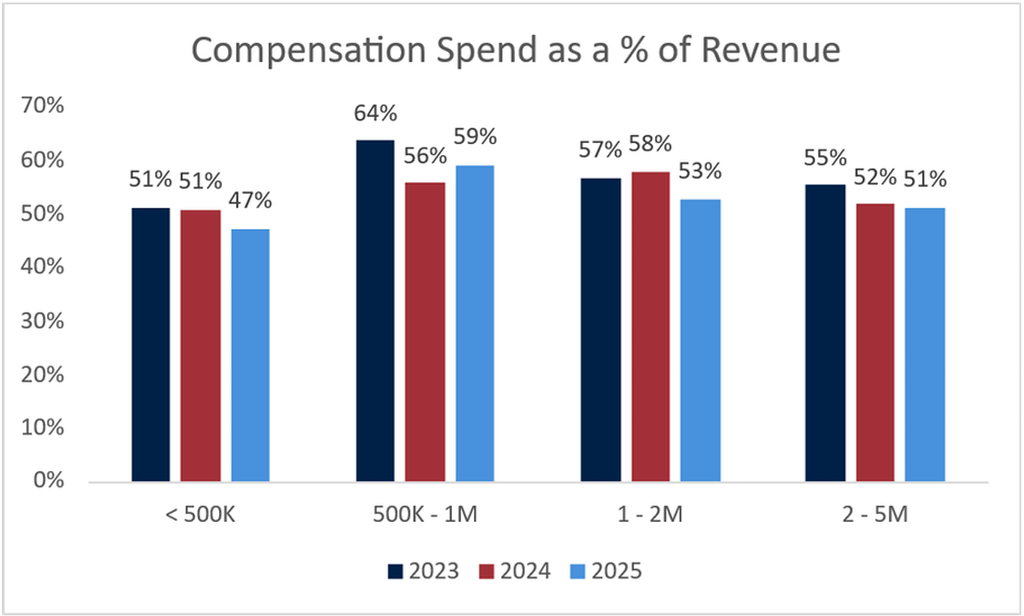
This edition of Valuation Views examines agency staffing and compensation. An agency’s team is an important consideration in its valuation, and owners planning for growth can benefit from tracking key performance indicators related to staffing and employee costs. Across every agency revenue band, IA Valuations observed a decline in compensation spending, including payroll and benefits, as a percentage of revenue between 2023 and 2025. Over that period, agencies generated more revenue relative to employee costs, indicating that compensation did not rise at the same pace as revenue.
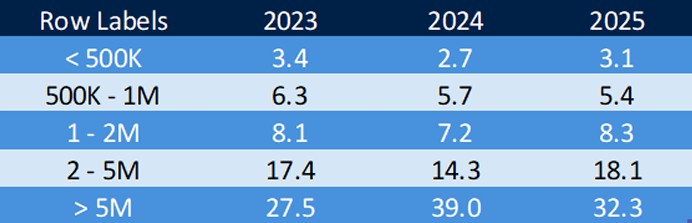
Between 2023 and 2025, net revenue per employee also rose across low-, middle-, and high-value agencies, suggesting that employees are supporting more revenue per person. What might explain this trend? Several factors may be contributing, including the P&C and health insurance rate environment, along with agency technology and the quality of agency operations.
If an agency has high net revenue per employee, it’s important to understand why. Has the agency developed processes that allow its team to support more business within existing working hours? Or are owners and employees working longer hours to serve more clients because of inefficient processes? Understanding what drives this capacity helps leaders evaluate whether growth is sustainable and how it affects the well-being of owners and employees. The answer can have important implications for agency value.
High-value agencies focus on developing processes and investing in systems that support higher revenue per employee while reducing the risk of staff burnout. The aim is to expand the team’s capacity in a sustainable way.
With its focus on staffing and compensation, this edition of Valuation Views offers insight into the conditions and trends other agencies are experiencing. It also features another recipient of IA Valuations’ Excellent Agency Distinction, highlighting one agency’s approach to recruiting and developing sales talent.
Compensation Spend by Revenue Band
The All-Agency Trend
Compensation spend as a percent of revenue declined 4.6% from 57.2% in 2023 to 52.6% in 2025. Over the same time period, agencies averaged a growth rate of around 10%. This decline in compensation spend relative to revenue size indicates agencies are generating more revenue for each dollar spent on employee compensation. Industry conversations suggest that many agencies would be comfortable investing more inn staff compensation than they are today, particularly as small agencies continue to look for opportunities to hire.
The “Scaling” Revenue Band
The $500K – $1M revenue band can be an inflection point for agency leaders: invest in staff to support growth or maintain their current operating model. Higher compensation spending as a share of revenue may reflect investments in staffing that meet current demand while creating capacity for future growth. As revenue grows into that capacity, compensation may decline as a share of revenue, provided staffing costs grow more slowly than revenue.
Compensation Spend by Value Segment
Metric Definitions
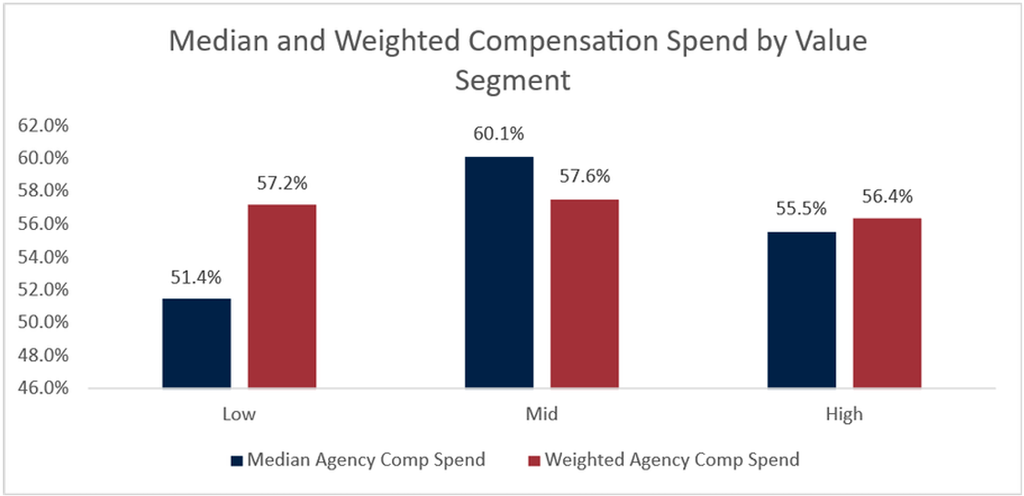
Weighted Agency Comp Spend: Of every $1 of net revenue generated by agencies in this segment, how many cents were spent on employee comp?
Median Agency Comp Spend: How much did the agency at the midpoint of the value segment spend on compensation?
Compensation Profile of High-Value Agencies
You might expect high-value agencies to spend substantially less on compensation as a share of revenue. Instead, the ratios are similar: 56.4% for high-value agencies, compared with 57.2% and 57.6% for the other value segments. These figures suggest that compensation spending alone does not account for differences in agency value.
In our valuation experience, the strength and depth of an agency’s team also matter. We consider whether capable employees are positioned to cover key roles, whether the sales team includes producers at different career stages, and whether the agency consistently develops new producers into validated producers. Together, these factors provide important context that the compensation ratio alone cannot capture.
Median Total Pay by Role and by Agency Market
Metric Definitions
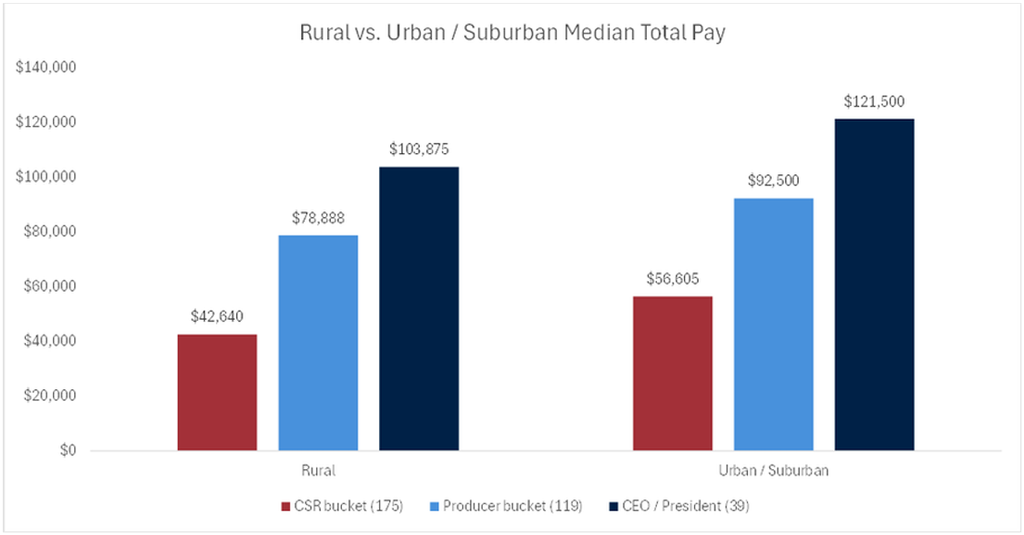
Median Total Pay: Agency reported Salary/Hourly Wage + Commission + Bonus comp.
Agency Staffing Profile
Staff Tenure:

Number of Staff:
Agency Efficiency is Increasing: Breaking Down Revenue Per Employee
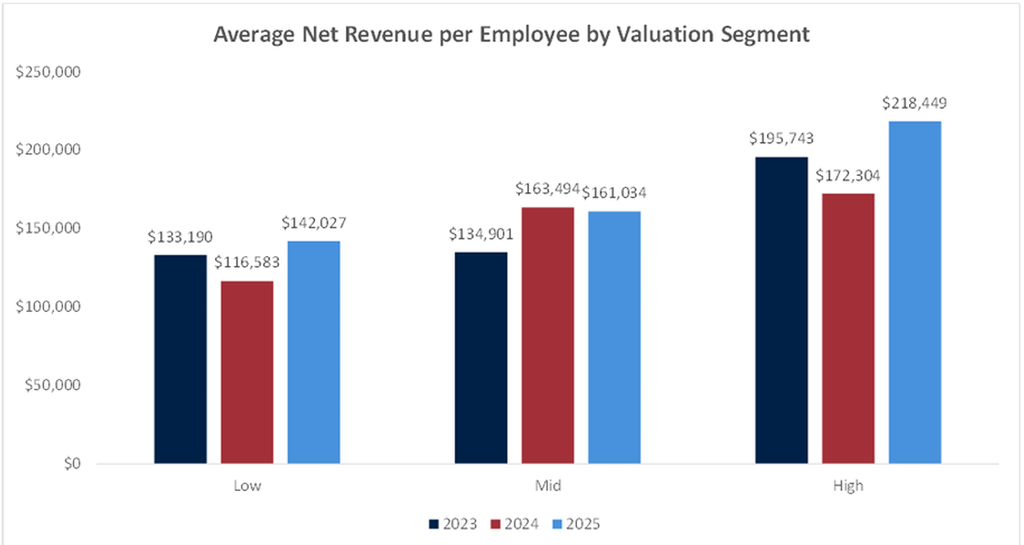
All-Agency Average
Overall, from 2023 to 2025, the average net revenue per employee increased by 22.4% or from $153,525 to $187,926.
Low-Valuation Segment
This agency segment experienced an increase in net revenue per employee of 6.6% on average or from $133,190 to $142,027.
Mid-Valuation Segment
This agency segment experienced an increase in net revenue per employee of 19.4% on average or from $134,901 to $161,034.
High-Valuation Segment
This agency segment experienced an increase in net revenue per employee of 11.6% on average or from $195,734 to $218,449.
The Long Game: Investing in the Next Generation
For many independent agencies, growth and hiring can feel reactive; a producer retires, a key employee leaves, or an opportunity emerges that requires additional staff. Recruiting often becomes a response to a need rather than a deliberate strategy. The O’Neill Insurance Agency has taken a different approach.
As a recipient of IA Valuations’ Excellent Agency Distinction, O’Neill has built a reputation for strong performance, intentional planning, and a commitment to investing in the next generation of talent. While the agency’s success has been decades in the making, owner Pat O’Neill’s philosophy is simple: the decisions agencies make today should position them for success down the road.

The agency’s growth story began in the 1990s when Pat’s father, Patrick, acquired a small local agency and spent more than a decade expanding it through both organic growth and acquisitions. Inspired by his father’s success, Pat pursued a career in insurance after graduating from Miami University, spending six years on the carrier side with Cincinnati Insurance before joining the agency. Over time, he developed as both a producer and a leader before purchasing the agency from his father and becoming the majority owner about 2.5 years ago.
The Power of Looking at the Numbers
Like many successful agencies, O’Neill Insurance was growing long before it adopted a formal, metric-driven approach to business planning. However, a pivotal moment came in 2019 when the agency began participating in Cincinnati Insurance’s Agency Leadership Institute and partnering with Reagan Consulting’s Best Practices to analyze agency performance. Those experiences helped the leadership team view their business through a new lens.
Rather than relying on instinct alone, they began to measure key performance indicators such as sales velocity, net unvalidated producer payroll (NUPP), and revenue per employee. Additionally, and perhaps more importantly, the O’Neill leaders set a lofty goal to invest in the next generation of leaders. That goal changed their approach to recruiting and producer development. Instead of waiting until they desperately needed talent, they began treating hiring as an ongoing business function.
Analyses showed that NUPP, a key metric for O’Neill Insurance, was too low. This is one way to measure investment into the next generation. So, they decided to increase their NUPP to reflect their commitment to the next generation. In order to do so, they would need to find some producers to invest in. It meant getting serious about recruitment. As Pat explains, “We treat finding producers like we do finding prospective clients.”
“We treat finding producers like we do finding prospective clients.”
The comparison is fitting. Just as agencies maintain pipelines of prospects, O’Neill strives to maintain a pipeline of future talent. Recruiting remains a constant priority, even when immediate openings do not exist. Some years, the focus is on hiring; other years, like this year, more resources are devoted to training and validating new producers. Either way, leadership is always trying to connect their actions to their goals.
Investing Before the Return Appears
One of the most important lessons from O’Neill’s experience is that meaningful growth and successful employee investment often require delayed gratification. Developing talent is expensive. It requires time, resources, mentoring, and patience. New producers typically do not generate immediate returns, especially when they come from outside the insurance industry. Yet O’Neill continues to make those investments because leadership understands the long-term value they create.
The agency’s current producer development efforts illustrate this commitment. Three newer producers are still unvalidated, requiring closer attention from agency leadership. One of these new hires is their intern from last year, who recently joined the team as an Associate Risk Advisor and is now progressing through an 18-month producer training program.
Finding these candidates requires creativity and persistence, and a significant financial investment. While recruiting and developing is a huge piece of what Pat does, he and his team are all busy with other client and operational tasks. They do their best to tackle hiring as a team and are not shy to outsource their recruiting. O’Neill has sourced talent through employee referrals, recruiting firms, talent acquisition specialists, networking, and internships. The agency also embraces candidates from diverse backgrounds, and while these individuals often require longer development timelines, the agency views that investment favorably when the person embodies the right values and matches the culture they’ve spent so long curating.
Culture as a Competitive Advantage
For O’Neill Insurance, hiring isn’t just about filling positions or finding technical expertise. Culture plays a critical role in every hiring decision.
The agency has developed a documented hiring process that includes interviews with multiple current employees, cognitive and behavioral assessments, and reference checks. However, leadership believes the final piece of the hiring puzzle often comes down to cultural fit. Culture is hard to define, which is why the leadership team developed a set of 30 “Fundamentals” to be their guiding light. These cultural fundamentals emphasize qualities such as accountability, integrity, respect, personal ownership, and having fun. Candidates are evaluated against these to try to identify a culture fit.
The result is an environment where employees are aligned around a common vision for how to treat clients and teammates, and where long-term investments in people have a greater chance of succeeding.

The Blueprint for Future Growth
O’Neill’s success is not the result of a single initiative. Rather, it reflects years of intentional investment across multiple areas of the business. Their journey began with leaders slowing down and working on the business, not just in it. They focused on growth and investment in the next generation. The agency has invested in leadership development, performance benchmarking, recruiting resources, technology, artificial intelligence, and multiple outside consultants for various areas of the business. Each investment supports a broader strategy centered on long-term growth and sustainability.
For agencies looking to strengthen their own future, O’Neill’s example offers an important reminder: sustained growth rarely happens by accident. The strongest agencies build plans, measure performance, develop talent pipelines, and make investments long before the results are visible.
That mindset is what separates agencies that react to change from those that are prepared for it. At O’Neill Insurance, the focus isn’t simply today’s tasks. It’s on equipping the next generation of leaders to do what’s best for the client, long after Patrick and Pat O’Neill are at the agency. Those qualities have contributed to the O’Neill’s long-term success and earned the agency a place in IA Valuations’ inaugural class of Excellent Agencies.
About IA Valuations and Agency Link – Founded in 2017, the IA Valuations team has performed over 400 valuations to independent insurance agencies across the U.S. Our advisors have 30+ years of experience guiding agency owners on maximizing their agency value, planning, and legal needs for ownership transition. In addition, IA Valuations has provided perpetuation planning, financial modeling and business planning for independent insurance agencies. Finally, IA Valuations has advised dozens of agency owners on selling their agencies through our Agency Link process. Agency Link is a platform that connects buyers and sellers together to further the growth and strength of the IA system. To learn more about IA Valuations, please visit IAValuations.com or contact@iavaluations.com.
The information provided in these documents is general in nature and shall not be construed as personal legal, tax or financial advice for your situation. Please contact@iavaluations.com to discuss your personal situation.
Copyright ©2026 by IA Valuations and Ohio Insurance Agents Association (OIA). All rights reserved. No portion of this document may be reproduced in any manner without the prior written consent of IA Valuations or OIA. In addition, this document may not be posted as a link on any public or private website without the prior written consent of IA Valuations or OIA.
At OIA and IA Valuations, we use AI tools (including, but not limited to, Co-Pilot, ChatGPT, Grammarly, and design platforms with AI features) to support the development of communications, professional development resources, and marketing materials. AI assists with drafting, analysis, and design but never fully automates these processes.
All AI-supported content is reviewed and approved by OIA/IA Valuations staff to ensure accuracy, relevance, and alignment with the independent insurance industry. We are committed to transparency, data protection, and ethical use of AI as a supportive tool—not as a replacement for human expertise.