
The New Competitive Edge: Attracting and Developing the Next Generation
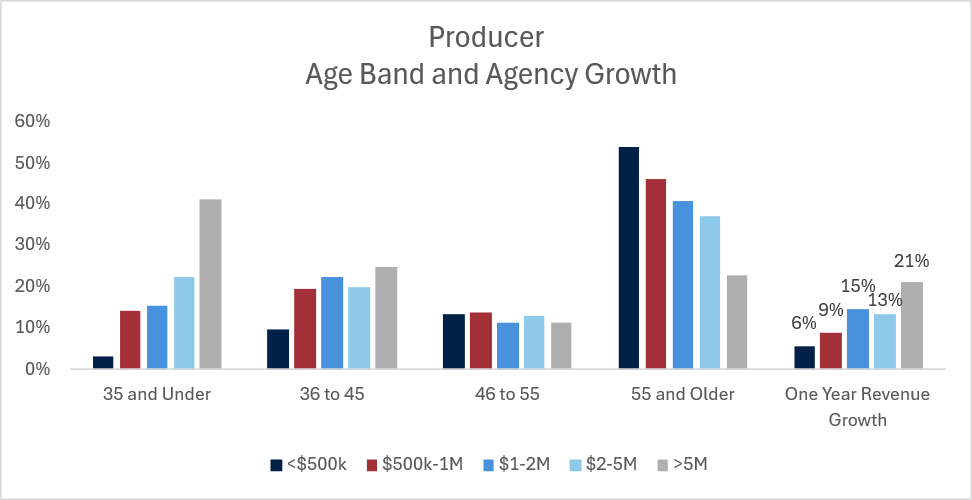
In today’s competitive insurance landscape, staffing transcends routine hiring; it’s a strategic imperative. IA Valuations’ 2025 Q3 data shows that agencies with a higher proportion of younger producers significantly outperform their peers. Agencies with 41% of producers under age 35 (among those over $5M in revenue) report 21.1% revenue growth versus just 5.6% in agencies dominated by seasoned talent. The message is clear: youth and innovation fuel performance and agency value.
Industry-wide research reinforces this point. The 2025 Insurance Labor Market Study by The Jacobson Group and Aon reports that 55% of insurers plan to expand their workforce, particularly in underwriting, claims, and technology roles, emphasizing the demand for tech-savvy professionals. Yet Vertafore notes that one in three agencies struggle to recruit younger talent, citing low interest among Millennials and Gen Z. Likewise, the Agency Universe Study found that 46% of agency owners view “finding and screening job candidates with strong potential” as extremely challenging, while retaining experienced staff and producers remain top concerns.
Our own data underscores that small to midsize agencies are hit hardest. More than half of smaller firms rely on producers over age 55 to drive growth. Beyond market access, staffing challenges were the only other issue to rank among agencies’ top 10 concerns in the hard market – highlighting how pervasive the talent gap has become across the IA system.
However, leading agencies are reframing staffing from a pain point to a strategic opportunity. Those that have intentionally invested in recruitment, development, and retention – through mentorship, flexible work options, competitive pay, and technology adoption – are seeing tangible results.
Whether your agency plans to perpetuate internally or sell externally when the time comes, cultivating younger talent is no longer optional. It’s essential to sustaining growth, driving innovation, and maximizing long-term value. This issue of Valuation Views explores these dynamics in depth and shares actionable insights for agencies to take the next step.
Age Banding of Producers in Relation to Growth Rate
Stats at a Glance:
Producer Age Banding: Key Insights
- Agencies with more young producers (35 and under) tend to have higher revenue growth.
- Agencies with older producers (55 and older) tend to have lower revenue growth.
- The middle age bands (36-45 and 46-55) show mixed or weaker correlations.
Less than $500k
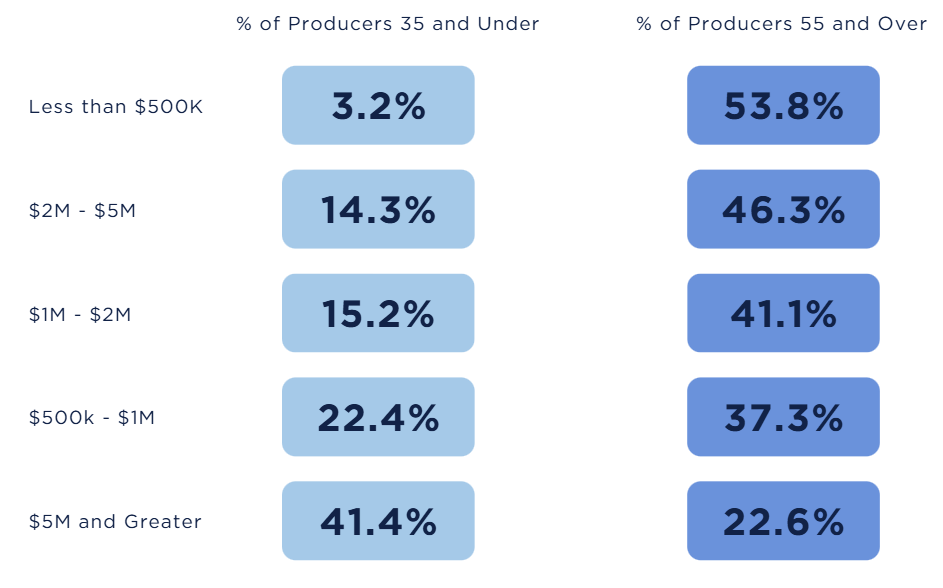
Only 3.2% of producers are 35 and under, while 53.8% are 55 and older – a gap of over 50 percentage points. These agencies show the lowest revenue growth (5.6%), suggesting that a predominantly senior workforce may limit innovation or adaptability.
Hiring Tip: Consider recruiting young producers to inject fresh energy and digital fluency. These agencies often have the least amount of time, capital, and structure to make new hires successful, so consider reaching out to your state trade association to see if they have programs to assist in your hiring efforts.
$500k – $1M
Young producers make up 14.3%, while older producers account for 46.3%, a gap of 32 percentage points. Revenue growth is modest at 8.9%. These agencies may benefit from a more balanced age mix.
Hiring Tip: Diversify your recruiting channels to reach younger professionals. Offering hybrid work arrangements and career development paths can make your agency more appealing to millennials and Gen Z.
1M – $2M
Producers 35 and under represent 15.2%, while those 55+ are 41.1%, a 26-point gap. These agencies show strong growth (14.7%), indicating that a moderate infusion of youth may be driving performance.
Hiring Tip: Continue building on this momentum by investing in digital onboarding and training programs that appeal to younger hires. Highlight growth opportunities and tech-forward tools in your recruitment messaging.
$2M – $5M
With 22.4% of producers under 35 and 37.3% over 55, the age gap narrows to 15 points. Revenue growth is solid at 13.2%. These agencies are striking a better balance and seeing results.
Hiring Tip: Maintain age diversity by fostering intergenerational collaboration. Promote internal mentorship and leadership development to retain both experienced and emerging producers.
Greater than $5M
These agencies have the highest percentage of young producers (41.4%) and the lowest percentage of older producers (22.6%), a reverse gap of nearly 19 points. They also lead in revenue growth (21.1%).
Hiring Tip: Continue investing in young talent through internships, referral programs, and tech-driven recruitment. Ensure your culture supports innovation and continuous learning to sustain growth.
Revenue Per Employee and Agency Size
All-Agency Average
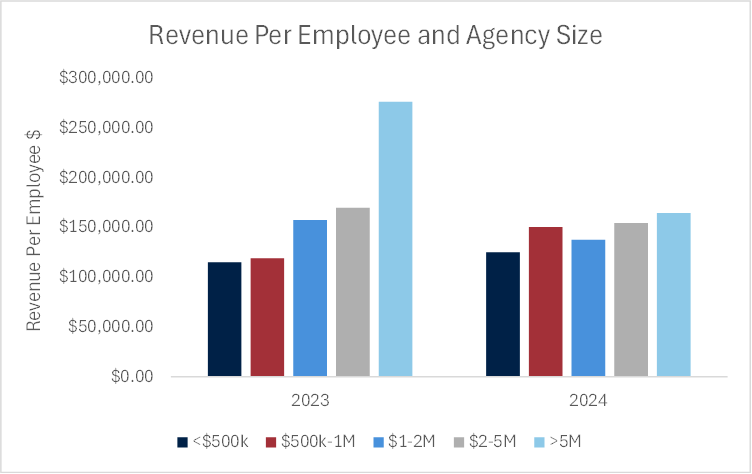
In 2024, the average revenue per employee for IA Valuations’ entire database was $139,485. This was a decrease of 3.6% compared to 2023. Now, let’s look at how each agency revenue group fared.
The Story Behind the Numbers
Revenue per employee has long been a benchmark that insurance agencies monitor. To increase the revenue per employee, an agency needs to either grow its revenue with the current number of employees or maintain its revenue with fewer employees. Conversely, a decrease in revenue per employee is due to either a decrease in revenue with the same number of employees or maintaining its current revenue with additional employees.
Less than $500k
This group saw their revenue per employee increase by 8.6% versus the prior year, with an average revenue per employee of $124,947. This number was 10.4% less than the all-agency average.
$500k-$1M
This group saw their revenue per employee increase by 26.3% versus the prior year, with an average revenue per employee of $150,369. This number was 7.8% greater than the all-agency average.
$1-$2M
This group saw their revenue per employee decrease by 12.6% versus the prior year, with an average revenue per employee of $137,447. This number was 1.5% less than the all-agency average.
$2-$5M
This group saw their revenue per employee decrease by 9.1% versus the prior year, with an average revenue per employee of $154,284. This number was 10.6% greater than the all-agency average.
Greater than $5M
This group saw their revenue per employee decrease by 40.2% versus the prior year. With an average revenue per employee of $164,492, the number was still 17.9% greater than the all-agency average.
While it’s difficult to say what is driving the number for each revenue band, increases could be attributed to market rates, which remain high, while agencies maintain steady headcounts. A decrease could be attributed to agencies with negative growth or perhaps those that are adding additional talent to prepare to drive organic growth when the market softens.
Catching Lightning in a Bottle in Small Town Ohio
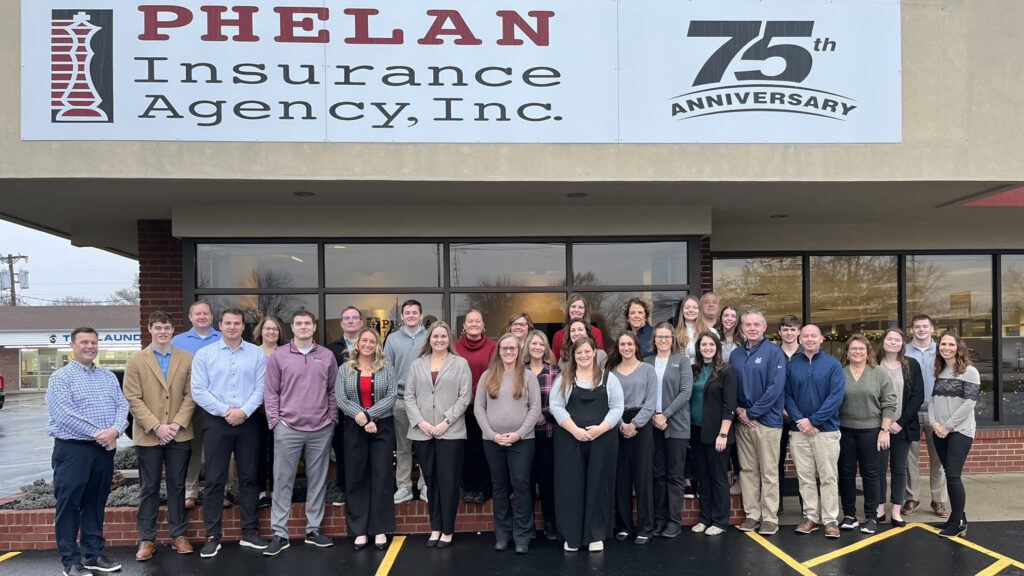
Phelan Insurance Agency in Versailles, Ohio is a tale of success for attracting and developing young talent in a small, rural town. In a small town like Versailles, sourcing and retaining young talent at a local business is a challenge, but Phelan Insurance has figured out its own secret formula.
About ten years ago, the agency faced a pivotal moment: a number of legacy producers were winding down their careers, and the business needed to figure out how they would continue to grow. These tenured producers had plateaued and were in a mindset of maintaining rather than growing. As they planned for the future, third-generation owners and brothers, Brent and Todd Phelan, developed a strategic growth plan.
So, how did they figure out how to hire in a town of 2,600 people? Experienced insurance industry people cannot be hired “off the rack” in a town of this size. Instead, they honed in on what characteristics their new hires must possess in order to succeed in meeting their agency’s growth goals.
The Phelan Hiring Formula
Work Ethic – Hard work is valued in rural Ohio.
The work culture is intense, yet enjoyable at Phelan Insurance. New hires needed to be hardworking and be perceived as such by their peers to fit into their environment. They found their recipe for success was a 50-hour work week for the first 3 years. They had never had a new producer fail when following these work hours, so they implemented this as the “gold standard.”
Culture Fit – New hires needed to fit in with the existing, successful employees.
Culture is one of the most important, yet yard to define, pieces of agency success. New hires and existing staff members need to mesh to create that intangible sense of unity and shared purpose that keeps Phelan’s culture strong.
“Old School” Coaching Style – Proven since 1949.
Since its founding in 1949, Phelan Insurance’s “old school” management approach has always worked. Their business is well-established, and they are not likely to change their ways. Not everyone is going to be happy and successful in this mold. They look at this aspect similarly to coaching style – some people need comfort, whereas others need tough love. Phelan is more likely to provide the tough love style to their employees, and successful employees are more likely to be aligned with this leadership style.
Building a Talent Pipeline
Through a community foundation, they created a scholarship fund and an internship program. Each year, they hire 1-3 college students to intern in the summer between their junior and senior year of college. This allows Phelan to give each intern a 10-12 week interview. The sales team includes the interns in their weekly meetings, they shadow them on calls and visits, they meet with carriers, and they do projects that relate to what they would realistically be doing as a producer in the agency.
Through this program, existing staff can get a feel for who they are and their work ethic. If, at the end of the summer, the intern “checks all the boxes” that Phelan Insurance is looking for, the intern is offered a job. Brent commented, “A student who accepts a job 9 months before starting it, most likely wants it, whereas a student who is offered a job post-graduation is most likely going to take it because they need it. We want people to want it.”
An additional, and more nuanced, piece of their hiring strategy is that they often find success with college athletes. Whether they are a D2 golfer or a D1 baseball player, former college athletes often share key traits that align with the demands of a sales role: discipline, teamwork, and competitiveness. While collegiate athletic experience isn’t a requirement, it’s one factor they consider.
Since they started this program, they haven’t had a single producer be unsuccessful.
Quality Over Quantity
They’ve realized that they don’t need to hire 10 successful producers per year to continue to meet their growth goals; they just need 1-3. The internship program has allowed them a longer vetting period for new producers and allows them to skip some of the pain points of onboarding. It also allows their staff to invest more time in the hiring process, which they see displayed in informal mentorship that allows for even greater success among the younger producers.
Their efforts towards hiring and growth are very intentional. “We feel like we’ve caught lightning in a bottle,” said Brent. They have continually met and surpassed their growth goals for the past 10 years. They realize this may not last forever, which is why they strategically plan and analyze their hiring practices yearly.
Growth Mindset
They also recognize that success requires consistent evaluation. For the past six years, Phelan Insurance has partnered with IA Valuations to conduct an annual agency valuation, an exercise Brent describes as “invaluable” for strategic planning. The reports highlight strengths, pinpoint opportunities for improvement, and provide benchmarks that guide decision-making.
Beyond internal growth, Phelan actively encourages younger staff to engage in the broader industry. The agency brought 12 producers to OIA’s annual conference, IACON, and one of their producers, Amanda, serves as chair of OIA’s Next Generation Advisory Committee. They regularly support attendance at industry and carrier events for networking and professional development. “We want our young producers to see that this is an exciting industry full of opportunity,” Brent said.
Phelan Insurance Agency recognizes that successful businesses are successful because of the people. By intentionally developing, supporting, and investing in their people, they see the same dedication reflected back in the agency’s continued success.
About IA Valuations and Agency Link – Founded in 2017, the IA Valuations team has performed over 270 valuations to independent insurance agencies across the U.S. Our advisors have 25+ years of experience guiding agency owners on maximizing their agency value, planning, and legal needs for ownership transition. In addition, IA Valuations has provided perpetuation planning, financial modeling and business planning for independent insurance agencies. Finally, IA Valuations has advised dozens of agency owners on selling their agencies through our Agency Link process. Agency Link is a platform that connects buyers and sellers together to further the growth and strength of the IA system. To learn more about IA Valuations, please visit IAValuations.com or contact@iavaluations.com.
The information provided in these documents is general in nature and shall not be construed as personal legal, tax or financial advice for your situation. Please contact@iavaluations.com to discuss your personal situation.
Copyright ©2025 by IA Valuations and Ohio Insurance Agents Association (OIA). All rights reserved. No portion of this document may be reproduced in any manner without the prior written consent of IA Valuations or OIA. In addition, this document may not be posted as a link on any public or private website without the prior written consent of IA Valuations or OIA.
Sources: